Umbilical hernia factsheet
An umbilical hernia is when a bulge can be felt or seen at the umbilicus, also known as the belly button.


An umbilical hernia is a soft lump under the skin at or around your belly button (umbilicus).
It happens when tissue from inside your abdomen (tummy) pushes through an abnormal opening of the abdominal wall. You can usually push the lump back in.
Umbilical hernias are common in babies and small children, and often disappear around the age of 4 or 5 years. In older children or adults, an operation is sometimes needed to repair the hernia.
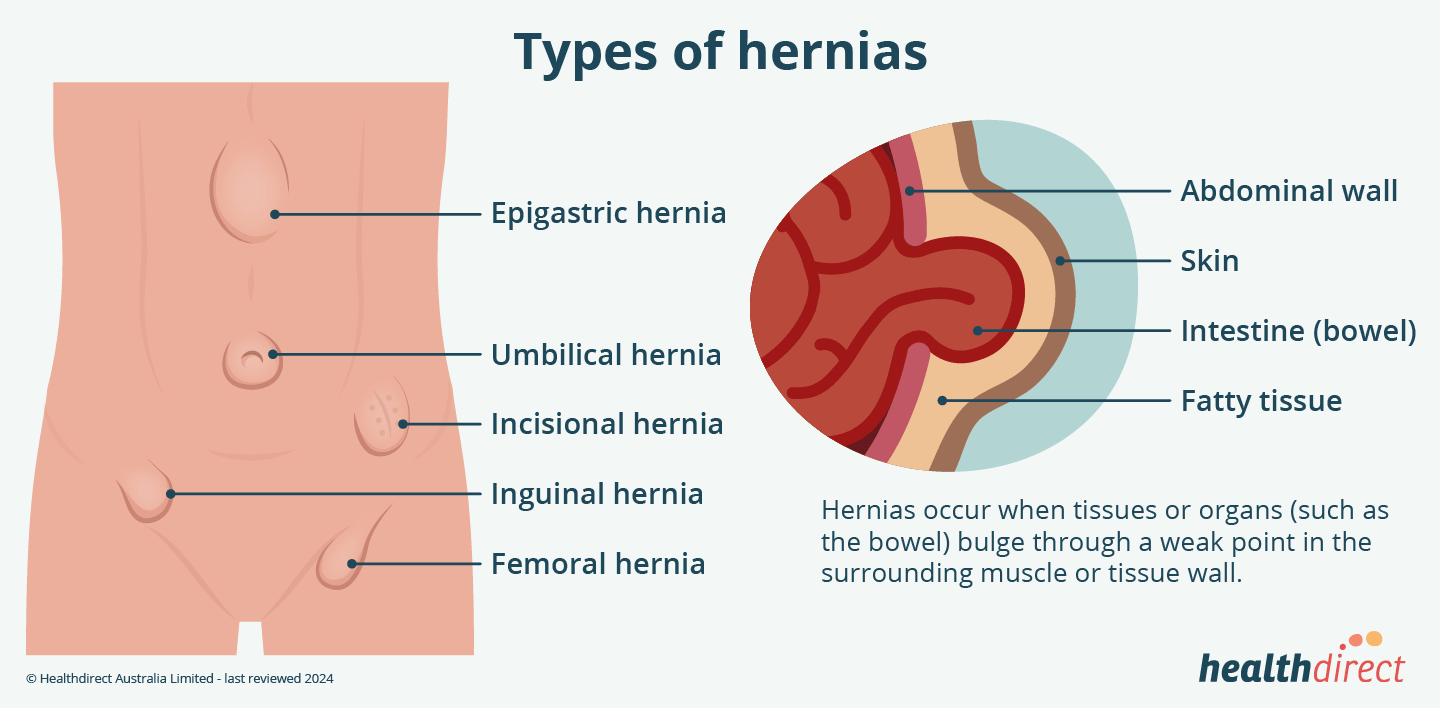
Illustration showing the locations of hernias (left) and the inside of a hernia where the bowel has pushed through the abdominal wall (right).
An umbilical hernia is a soft lump or bulge under the skin near your belly button. The hernia may be more noticeable when:
Most umbilical hernias are not painful. Some people may have mild discomfort.
The area where your umbilical cord (Opens in new tab) is cut turns into your belly button. There is a ring of muscle around your belly button that closes after birth. Umbilical hernias in children happen when it takes longer than usual for this ring to close.
Umbilical hernias are more common in babies who are born with a low birth weight (Opens in new tab) or born prematurely (Opens in new tab).
In adults, umbilical hernias may happen when there is a weakness in the wall of your abdomen. Factors that may contribute are:
All children and adults with a hernia should see a doctor, as there may be complications.
Your doctor will ask about your or your child's symptoms and do an examination.
An umbilical hernia can usually be diagnosed with a physical examination.
Sometimes, an ultrasound scan may be done to confirm the diagnosis in adults.
Most umbilical hernias in children close by the age of 5 years. If the hernia hasn't closed by then, or if it's large, surgery may be needed to repair the hernia.
A hernia repair is done under general anaesthetic. The procedure can usually be done as day surgery.
Your child will need to rest for a day or 2 after an umbilical hernia repair. Your doctor may recommend pain-relief medicines as needed.
Surgery will usually be needed to treat an umbilical hernia in adults. Hernia repair is needed if your hernia is causing symptoms or getting bigger.
The operation can usually be done as day surgery. You may need to take it easy and limit your activities for around 2 weeks after the surgery.
Rarely, a part of your bowel, other abdominal organs or tissue can become trapped inside the umbilical hernia. This is called an 'incarcerated hernia'. It causes pain and discomfort. You may not be able to push the hernia back in.
If the blood supply to the bowel inside your hernia is cut off, this is called a 'strangulated hernia'.
If part of the bowel inside your hernia gets blocked, you can get a bowel obstruction. This causes vomiting, abdominal (tummy) pain and severe constipation.
Emergency medical treatment is needed in these situations.
Adults are more at risk of developing an umbilical hernia if they are overweight or have had surgery that weakens the abdominal wall.
If you already have an umbilical hernia, you can prevent it from getting worse by:
Talk to your doctor if you have questions about an umbilical hernia.
The Sydney Children's Hospitals Network has information on umbilical hernias in children (Opens in new tab).
You can also call the healthdirect helpline on 1800 022 222 (known as NURSE-ON-CALL in Victoria). A registered nurse is available to speak with 24 hours a day, 7 days a week.
Find out how we develop and review our content.
Last reviewed: September 2024


Worried about your health?
Select a symptom, answer some questions, get advice