Medical problem? Call healthdirect on 1800 022 222. If you need urgent medical help, call triple zero (000) immediately. healthdirect is a free service where you can talk to a nurse or doctor who can help you know what to do.
Swallowed object
Warning:
If someone has swallowed a button battery or magnet, call triple zero (000) or go to the nearest hospital emergency department. Don't try to make them vomit and don't let them eat or drink anything. Don't wait for symptoms to develop.
Key facts
Sometimes people accidentally swallow something they shouldn't.
While most swallowed objects can move through your body without a problem, some objects can be very dangerous if they are swallowed.
Button batteries are very dangerous when swallowed — they can cause serious injury or death.
Large and sharp objects, magnets and objects made of lead are also dangerous to swallow.
What is a swallowed object?
A swallowed object usually refers to any item that should not be swallowed. Healthcare professionals may call it an 'ingested foreign body'.
Sometimes people swallow non-food items that can be dangerous.
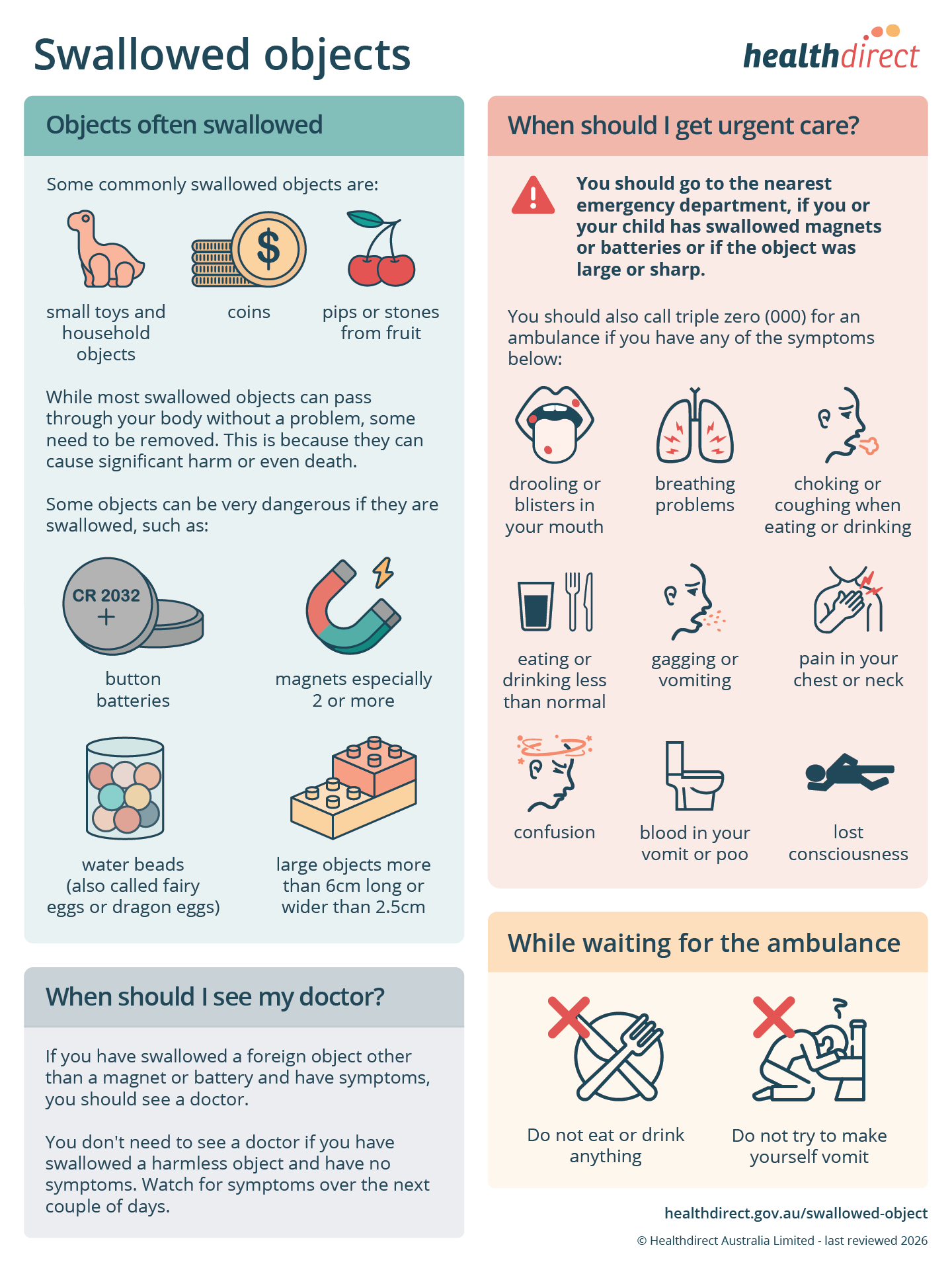
Some commonly swallowed objects are:
coins
small toys
household objects
While most swallowed objects can pass through your body without a problem, some need to be removed. This is because they can cause significant harm or even death.
Some objects can be especially dangerous if they are swallowed, such as:
magnets — especially 2 or more
button batteries — which can burn through the lining of your oesophagus (food pipe), causing serious injury or death
water beads
Water beads, or super-absorbent polymer balls, can expand up to 400 times their original size when placed in liquid. These toys are also called jelly beads, water balls or fairy beads. If you think someone has swallowed a water bead, seek medical attention straight away.
If you need to see your doctor but cannot wait for an appointment, you may be able to get treatment at a Medicare Urgent Care Clinic. Use the Service Finder to find your nearest one.
Button batteries and magnets need to be removed immediately to avoid serious complications, which can be life-threatening.
Symptoms can differ depending on what object you've swallowed and if the object becomes stuck. A child often won't have any symptoms when they have swallowed an object.
Objects can sometimes get stuck in your oesophagus, which can cause:
If you, or someone you know, is having suicidal thoughts and is in immediate danger, call triple zero (000). For help and support, call Lifeline on 13 11 14.
How is a swallowed object diagnosed?
Your doctor will ask you what object was swallowed and when this happened.
They may do an x-ray if the object is made of a material that will show up on an x-ray.
When should I see my doctor?
Warning:
If someone has swallowed a button battery or magnet, call triple zero (000) or go to the nearest hospital emergency department. Do not wait for symptoms to develop.
If you have swallowed a foreign object other than a magnet or battery and have symptoms, you should see a doctor.
You don't need to see a doctor if you have swallowed a harmless object and have no symptoms. Watch for symptoms over the next couple of days, and seek medical advice if you develop pain, vomiting or trouble swallowing.
When should I get emergency care?
Call triple zero (000) and ask for an ambulance, or go to the nearest emergency department, if you have:
swallowed a button battery or magnet
swallowed a large object
swallowed a sharp object
tried to harm yourself
You should also call triple zero (000) and ask for an ambulance if you notice symptoms such as:
Do not eat or drink anything until you have spoken to a doctor.
Do not try to vomit, as this could cause choking or block your airway.
How is a swallowed object treated?
Depending on what object was swallowed and where it is in your digestive system, the object may need to be removed.
Objects in the oesophagus often need to be removed, depending on the symptoms.
Most objects in the stomach or bowel will pass through on their own.
Button batteries and magnets need to be removed immediately.
Most objects can be removed using an endoscope (a thin, flexible tube with a light and camera at the tip). The endoscope can be used to find and remove the object.
Sometimes surgery is needed to remove a swallowed object.
Self-care at home
If you swallow a foreign object that is not one of the dangerous objects listed above and have no symptoms, you may not need to have the object removed. There is no need to look in your faeces (poo) to find the swallowed object.
How do you stop children from swallowing objects?
Keep all small objects away from young children. Small objects that can be swallowed include:
coins
pins
magnets
small toys
button batteries
Also, make sure that all remote controls and toys that contain button batteries are kept out of reach.
What are the complications from swallowed objects?
For more information on poisonous substances, read the article on poisoning.
If you think you or your child has swallowed a poison, call the Poisons Information Centre on 13 11 26.
You can also call the healthdirect helpline on 1800 022 222 (known as NURSE-ON-CALL in Victoria). A registered nurse is available to speak with you 24 hours a day, 7 days a week.
This document provides clinical guidance for all staff involved in the care and management of a child presenting to an emergency department in Queensland with a suspected or confirmed ingested foreign body.
This document provides clinical guidance for all staff involved in the care and management of a child presenting to an emergency department in Queensland with a suspected or confirmed foreign body in the ear.
Queensland Health is urging families to stay vigilant during the festive season. The last thing any family wants is to end up in an emergency department on Christmas Day because a child has swallowed or choked on a button battery, or inserted into their ear or nose.
Button batteries are dangerous and can cause serious injuries or death if swallowed or inserted. Act immediately if you suspect your child has swallowed or inserted a button battery.
Choking occurs when the trachea is completely or partially blocked by a foreign body (food, liquid or another object), obstructing airflow. Choking can be gradual or sudden, and it may only take a few seconds for the airway to become completely blocked. The specific symptoms experienced by a choking person will depend on the foreign body causing the obstruction and the severity of the blockage.
The historical pathologising of older lesbian, gay, bisexual, transgender and intersex (LGBTI) people’s bodies and relationships continue to adversely affect their health and wellbeing
Our bodies need long periods of sleep in order to restore and rejuvenate, repair tissue, grow muscle and synthesise hormones, among other important processes. It is worth emphasising the importance of sleep to your patients. Sleep deprivation will not only hinder the healing process but may also introduce other significant health problems into their lives.
Most occupational exposures to blood or body fluids carry a low risk of transmission of bloodborne viruses; however, it is important to recognise incidents that carry a higher risk of transmission and to know when postexposure prophylaxis is required.
Multiple sclerosis (MS) (which means ‘many scars’) is an incurable neurological condition. It is characterised by an abnormal immune response that targets myelin, a fatty material responsible for insulating the nerve fibres in the central nervous system (CNS) (which comprises the brain, spinal cord and optic nerves).
Cortisol is a hormone produced by the two adrenal glands, which are located on top of each kidney. The pituitary gland in the brain regulates cortisol production. Cortisol plays an important role in the stress response. Maintaining an adequate balance of cortisol is essential for health.
Medicines aim to prevent, cure or control various disease states. To achieve this goal, adequate concentrations of the medicine must be delivered to the target tissues so that therapeutic, yet non-toxic levels, are obtained.
High-pressure injection injuries, which occur when foreign material is accidentally injected into the skin via high-pressure industrial equipment, may resemble nothing more than a pin-sized hole. However, despite their inconspicuous appearance, these injuries are a surgical emergency at best - and cause for amputation at worst.
Body temperature is a vital sign used to assess the body’s ability to create and expel heat. When measured together with other vital signs, body temperature can help paint an overall picture of a patient’s health and assess circulatory, respiratory, neural and endocrine functioning.